
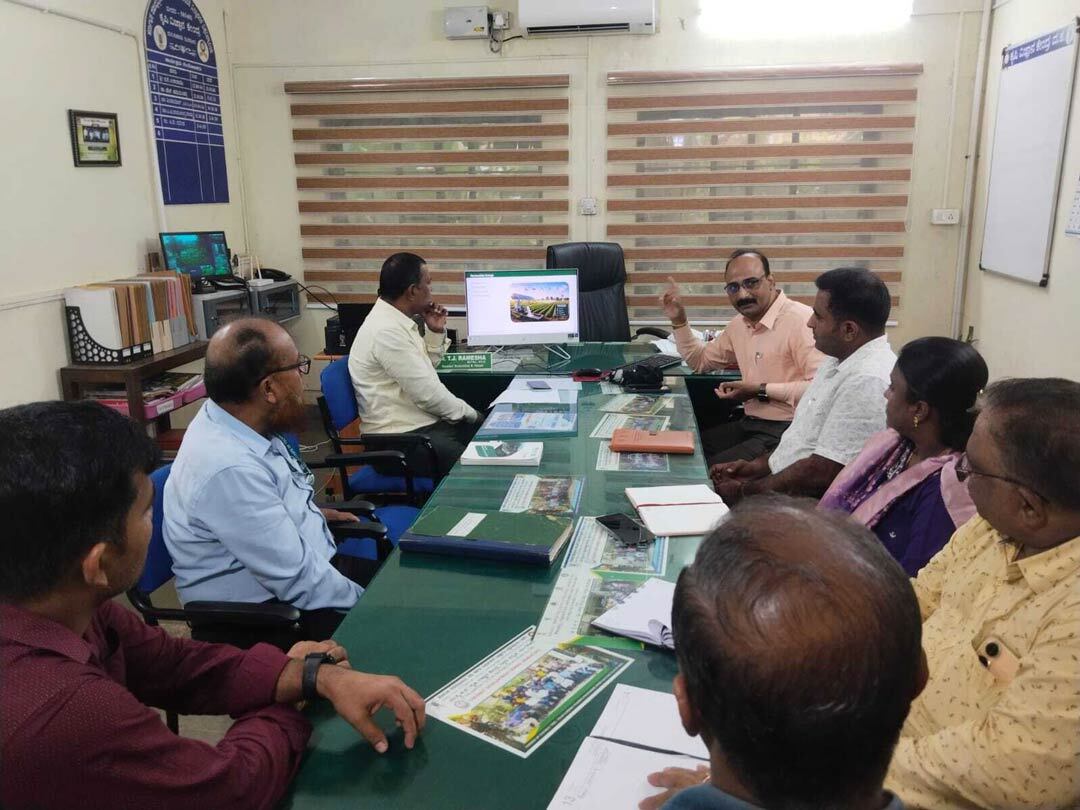
Bearys Institute of Technology (BIT), Mangaluru, conducted an Industry Interaction Visit to Krishi Vigyan Kendra (KVK), Mangaluru on 1 July 2026 to explore collaborative opportunities in sustainable agriculture, fisheries, research, consultancy, rural development, and technology-driven innovations. The interaction aimed to identify interdisciplinary engineering solutions to address challenges in the agriculture and fisheries sectors through meaningful academia–industry collaboration.
The BIT delegation comprised Dr. C. Kamalakannan, Principal, Dr. Imran Mokashi, HOD, Mechanical Engineering & IQAC Coordinator, and Dr. Abdullah Gubbi, HOD, Electronics & Communication Engineering. The team was received by Dr. T. J. Ramesha, Senior Scientist & Head, Krishi Vigyan Kendra, along with scientists from the Agriculture and Fisheries divisions.
The programme commenced with a welcome address by Dr. T. J. Ramesha, who welcomed the BIT delegation and introduced the KVK scientists. This was followed by a presentation by Dr. C. Kamalakannan, Principal, BIT, highlighting the institute’s vision of partnering with agricultural and fisheries organizations to develop sustainable engineering solutions. The presentation showcased the institute’s strengths in Artificial Intelligence (AI), Internet of Things (IoT), automation, renewable energy, smart agriculture, smart fisheries, research, consultancy, technology transfer, student internships, and community engagement. A roadmap for collaboration through pilot projects, Centres of Excellence, joint research, consultancy services, and technology transfer was also presented.
An interactive discussion was held between the representatives of both organizations to identify areas of mutual interest for research and technology development. Key areas discussed included the development of a lake-cleaning system to improve water quality and reduce fish mortality, AI-based crop disease detection, soil health monitoring, women-friendly agricultural tools, mechanized harvesting systems, and IoT-enabled real-time monitoring solutions for agriculture and fisheries. The interaction also explored opportunities for collaborative consultancy, externally funded research projects, faculty collaboration, student internships, live projects, and rural outreach initiatives.
One of the significant outcomes of the interaction was the mutual agreement to establish a collaborative partnership between BIT and KVK in research, consultancy, technology development, and knowledge exchange. Punacha, the adopted village of Bearys Institute of Technology, was identified as the pilot village for implementing and evaluating engineering-based solutions. Both institutions also agreed to formalize the partnership through a Memorandum of Understanding (MoU), creating opportunities for long-term collaboration in research, innovation, skill development, and community engagement.
The visit marked an important step towards strengthening academia–industry collaboration by integrating engineering expertise with agricultural and fisheries research to develop sustainable and socially relevant technological solutions for rural development.